Parable:a story designed to convey some religious
principle, moral lesson, or general truth.
Paradox:a statement apparently self-contradictory or
absurd but really containing a possible truth; an opinion contrary to generally
accepted ideas.
Parallelism: the principle in
sentence structure that states elements of equal function should have equal
form.
Parody:an imitation of mimicking of a composition or
of the style of a well-known artist.
Pathos:the ability in literature to call forth
feelings of pity, compassion, and/or sadness.
Pedantry: a display of learning
for its own sake.
Personification: a figure of
speech attributing human qualities to inanimate objects orabstract ideas.
Plot: a plan or scheme to
accomplish a purpose.
Poignant:eliciting sorrow or sentiment.
Point of View: the attitude
unifying any oral or written argumentation; in description, the physical point
from which the observer views what he is describing.
Postmodernism: literature
characterized by experimentation, irony, nontraditional forms, multiple
meanings, playfulness and a blurred boundary between real and imaginary.
Prose:the ordinary form of spoken and written
language; language that does not have a regular rhyme pattern.
Protagonist: the central character
in a work of fiction; opposes antagonist.
Pun:play on words; the humorous use of a word
emphasizing different meanings or applications.
Purpose: the intended result wished
by an author.
Realism:writing about the ordinary aspects of life in
a straightfoward manner to reflect life as it actually is.
Refrain:a phrase or verse recurring at intervals in a
poem or song; chorus.
Requiem:any chant, dirge, hymn, or musical service
for the dead.
Resolution: point in a literary
work at which the chief dramatic complication is worked out; denouement.
Restatement: idea repeated for
emphasis.
Rhetoric: use of language, both
written and verbal in order to persuade.
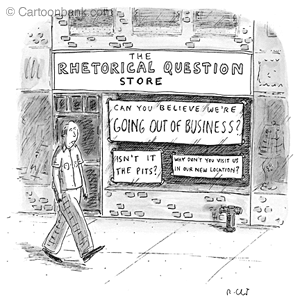
Rhetorical Question: question
suggesting its own answer or not requiring an answer; used in argument or
persuasion.
Great job on the Lit terms 83-108. I look forward to seeing more from you. I really liked how you embedded youtube videos into the blog. Very nice touch.



Great job on the Lit terms 83-108. I look forward to seeing more from you. I really liked how you embedded youtube videos into the blog. Very nice touch.
ReplyDelete